Parkinson's Disease Treatments with NADH
Summary: Good news, 78% of the patients in a Parkinson’s  disease clinical study experienced positive improvements when taking an NADH supplement. NADH is a nutritional supplement that is a natural, energy-giving, co-enzyme found within every human cell. Since the mid-eighties, NADH has been used in Europe to successful treat more than 3,000 Parkinson's patients. To validate these treatments, an open label clinical trial study (a link to the actual study is listed below) was held with 885 Parkinson's disease patients taking 25mg of NADH daily. The 885 patient clinical trial validated that in 78% of the cases, patients taking NADH daily reported positive improvements in their condition.
Recent research states that using a higher than 25mg daily dose of NADH would have better results than experienced in the clinical trial. In the video below, the Dr. recommends a Parkinson’s disease patient should take 40mg (or more) of NADH daily to experience a 10% to 60% improvement in their condition. The Dr. suggests the patients should see improvements in their condition in about two weeks.
The Clinical Study Publication (click to download):

NADH used to successfully treat 885 Parkinson’s Patients 78% experienced positive improvements in their condition

Successful Parkinson's disease treatment with NADH -
Dr Birkmayer is making the presentation [00:53]
Parkinson's patients taking NADH with a (remarkable) positive effect [03:06]
The Full Text of "Parkinson's disease and NADH"
(This Full Text section may repeat video(s) & clinical study publications found in the Summary)
The Clinical Testing:
 Since the mid-eighties, NADH has been successfully used to treat more than 3,000 Parkinson's disease patients. These treatments were in Europe, and not in the United States. A majority of the Parkinson’s disease patients experienced varying levels of positive improvements in their condition. To validate these results, an open label trial with 885 Parkinsions disease patients were given 25mg of NADH daily. About half of the patients received NADH by intravenous means (a needle), and the other half received oral tablets. The patients that received the 25mg of NADH oral tablets experienced the best results. (The actual Parkinson's disease clinical study is available, see the document link.) The clinical study document is technical in nature, difficult to read, and is usually read by healthcare professionals. We recommend taking the study to your healthcare professional and discuss its results.
The study found there were three things that had significant influence on the improvement in condition. They are:
- the degree of the patient's disability before the treatment
- the duration of the disease within the patient before the treatment
- the age of the patient
In the simplest of terms, the younger patients, with a shorter duration of the disease, have the best chance to obtain the most significant improvements in Parkinson’s disease symptoms. The stages of the disease are important. If the Parkinson's disease is in the most advanced stages, it is very difficult to show improvement.
The clinical tests showed 78% of the patients taking NADH experienced varying levels of beneficial improvement. The percentages in improvement were:
- 19.3% of the patients showed a very good (30% to 50%) improvement
- 58.8% of the patients showed a moderate (10 - 30 %) improvement.
- 21.8 % of the patients did not respond to the NADH
NADH: A Background
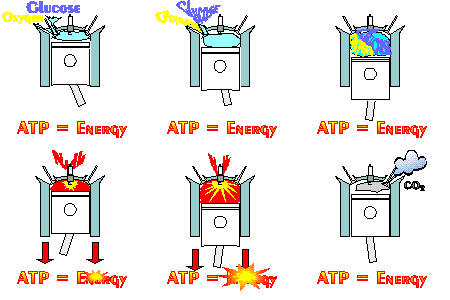 The NADH Parkinson’s disease treatment comes from a coenzyme called NADH or nicotinamide adenine dinucleotide with the ‘H’ standing for hydrogen. What makes NADH promising is Mother-Nature uses NADH to create mental and physical energy (called ATP) within all human cells. ATP energy creation takes place in a process called "cellular respiration." Cellular respiration is not breathing. Cellular respiration works like a car (in this case, cell) engine, creating energy used to power all living things (i.e., thought, memory, muscle movement, heart beats, etc.). Within the cellular respiration engine, all human cells bring glucose (fuel) and oxygen (air) together, and with the spark of NADH (the spark plug) creates life's energy and power (ATP). ENADA / Co-E1 is an NADH nutritional supplement that has successfully reproduced the NADH co-enzyme in a stabilize form and is administered within a tablet. For more information about NADH in nature, take this website’s The Guided Tour.
Doctors who have tested NADH on patients have stated:
- NADH is a safe, natural compound that has shown much promise with patients in Europe.
- Much more extensive research is needed.
- A clinical trial for the treatment of Parkinson’s disease patients is a significant step, down a long road to investigate the many potential benefits of this natural coenzyme called NADH.
NADH is a coenzyme. The American Heritage Dictionary defines a coenzyme as:
- a non-protein organic substance that usually contains a vitamin or mineral and combines with a specific protein, to form an active enzyme system
NADH is not a drug, not a stimulant, and is non-toxic even in very large dosages. NADH has been tested for 26 weeks at 1,000mg daily - with no negative side-effects. Since NADH is already found within every human cell, NADH can safely be taken with any other medication. After extensive human trial safety testing, it was proven NADH does not have any negative side effects and no adverse drug interactions. See this website’s section called Safety First for more information.
The most important things to remember about the NADH, is that NADH is found in every human cell, and:
- NADH increases the levels of cellular energy (ATP). The more NADH cells have -- the more ATP-energy cells produce. NADH increases cell longevity.
- NADH is a powerful antioxidant, a scavenger of free radicals. According to Dr. Passwater, "NADH may just be the most powerful antioxidant"
- NADH is the active ingredient in cellular repair and DNA repair. It repairs cellular damage.
- NADH stimulates the immune system.
- NADH enhances the production of dopamine, a very important brain chemical (also known as a neurotransmitter)
- NADH increases the bio-availability of nitric oxide, known to provide increased blood flow, oxygen delivery, glucose uptake, muscle velocity, power output, and muscle growth
Parkinson’s disease: The Illness
 Parkinson’s disease is a degenerative brain disorder initially characterized by trembling lips and hands, muscular rigidity and the slowing of movement. It develops gradually. As the disease progresses, it produces body tremors, a shuffling gait, and eventually a possible incapacity. Emotions may be affected. Mental capacity may be impaired. Depression often accompanies the disease. In the early stages of Parkinson's disease, the face may show little or no expression or the arms may not swing when you walk. Speech may become soft or slurred. Parkinson's disease symptoms worsen as the condition progresses over time.
The cause of Parkinson's disease is unknown, but several factors appear to play a role, including:
- The person’s genes. Researchers have identified specific genetic mutations that can cause Parkinson's disease. These are uncommon except in rare cases when many family members are being affected by Parkinson's disease.
- Certain gene variations appear to increase the risk of Parkinson's disease but it is a relatively small risk for each of these genetic variations.
- Environmental triggers. Exposure to certain toxins, herbicides, pesticides and other environmental factors may increase the risk of Parkinson's disease, but the risk is relatively small.
- In summary, more research needs to be done to identify the factors that cause Parkinson's disease.
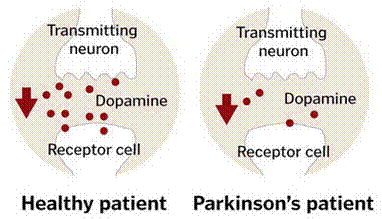
In Parkinson's disease, certain nerve cells (neurons) in the brain gradually break down and die. Many of the symptoms are due to loss of brain cells (neurons) that produce a chemical messenger in your brain called dopamine (also known as neurotransmitters). When the brain cells that produce dopamine, stop producing dopamine, the dopamine levels decrease, and that causes abnormal brain activity, which leads to signs of Parkinson's disease. Parkinson’s disease is named for the English surgeon James Parkinson, who first described it in 1817.
Parkinson’s disease: Who Will Be Affected?
Who will be affected by Parkinson’s disease is unknown, but the following risks have been identified:
- Age. Young adults rarely experience Parkinson's disease. It ordinarily begins in middle or late life, and the risk increases with age. People usually develop the disease around age 60 or older
- Heredity. Having a close relative with Parkinson's disease increases the chances that you'll develop the disease. However, your risks are still small unless you have many relatives in your family with Parkinson's disease
- Sex. Men are more likely to develop Parkinson's disease than are women
- Exposure to toxins. Ongoing exposure to herbicides and pesticides may put a person at a slightly increased risk of Parkinson's disease
Parkinson’s disease: Diagnosis & Current Treatment:
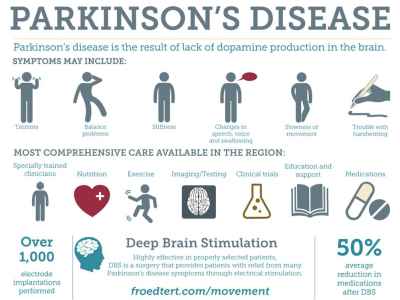 Although Parkinson's disease can't be cured, there are medications that are known to improve the symptoms of Parkinson’s disease. In occasional cases, the doctor may suggest surgery to regulate certain regions of your brain and improve the symptoms. Parkinson’s disease is treated with these drugs: sinemet, deprenyl (selegiline), L-DOPA (given with carbidopa to reduce side effects), amantadine and others. Parkinson's disease usually refers to similar symptoms resulting from certain anti-psychotic drugs (taken by the mentally ill), reserpine (a blood pressure medication), carbon monoxide poisoning, or MPTP (a byproduct of heroin usage).
It is the decreased levels of dopamine that causes abnormal brain activity, which leads to signs of Parkinson's disease. Dopamine is a monoamine neurotransmitter formed only in the brain by the decarboxylation of dopa. Dopamine is essential to the normal functioning of the central nervous system. A reduction in dopamine concentration within the brain is associated with Parkinson’s disease and Parkinsonism symptoms.
Conclusion:
NADH is found within all human cells - so it is safe. Testing has proven there are no drug interactions, nor any adverse side effects when taking a daily NADH supplement. In the open clinical trial study, a daily dose of 25mg of NADH was given to 885 Parkinson's disease patients. The clinical trial provided significant positive results. As seen in the video, the Dr. who administered the NADH recommended to increase the daily dose of NADH to 40mg (or higher) to treat Parkinson's disease.
NADH increases the levels of cellular energy (ATP). It is a powerful antioxidant. It is the active ingredient in cellular repair and DNA repair. NADH stimulates the immune system and most importantly NADH enhances the production of dopamine (and studies prove there are low levels of dopamine in Parkinson’s disease patients).
The lack of physical or mental energy correlates with a lack of life’s energy called ATP. Every living cell produces ATP (also known as adenosine triphosphate) in a process called "cellular respiration." The human body uses ATP energy to enable the brain to provide: thinking, memory, mental clarity, etc. and enables muscles to provide: movement, stamina, physical endurance, etc. See this website’s section called ATP Energy for more information. Clinical studies have proven, the more NADH a cell has, the more ATP the cell will produce. NADH is as important as oxygen (air) and glucose (digested food) in the production of life’s energy (ATP). For more information about the production of NADH, take this website’s The Guided Tour.
 The brain and the muscles need to contain high levels of NADH. If the cellular NADH levels are depleted, the brain or muscles will no longer function properly. It is NOT known, how NADH becomes depleted from the body. Today, a scientific breakthrough has enabled NADH to be manufactured in a stabilized, tablet form. A person can restore NADH cellular levels by taking a nutritional supplement. High NADH levels, means higher levels of ATP (energy). The same NADH nutritional supplement used in the clinical study is available from this website or high quality nutritional supplement stores. It has taken decades to create a stabilized form of NADH. Please use only the stabilized form of NADH (see this website's page called Let the Buyer Beware) The stabilized form of NADH is the only product we sell
With this knowledge -- it stands to reason, taking NADH could help some Parkinson’s disease sufferers. The clinical study states that it does not help everyone and it does not help with all symptoms. But helping 78% of the Parkinson's disease sufferers even a little -- is better than no help at all. And help in treating the actual disease is better that treating the symptoms of a disease.
Take a copy of the clinical study to your healthcare professional and discuss the options. The clinical study is yours to take. Order the same NADH used in the clinical study from this website or other high quality nutritional supplement stores. A high quality FDA licensed laboratory environment used to manufacture NADH to ensure that each and every tablet or lozenge is of the highest, professional grade standard.
Clinical Study Publications (click to download):
NADH used to successfully treat 885 Parkinson’s Patients 78% experienced positive improvements in their condition
The More NADH is in the Blood - the More ATP Energy is in the Cell
NADH Nutritional Supplements Elevate ATP Energy Within the Cell
 Video Section:
 Video Section:
Successful Parkinson's disease treatment with NADH -
Dr Birkmayer is making the presentation [00:53]
A Parkinson's disease patient taking NADH with a (remarkable) positive effect [03:06]